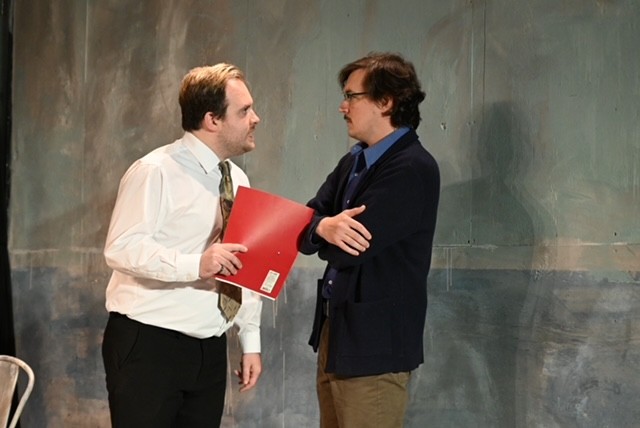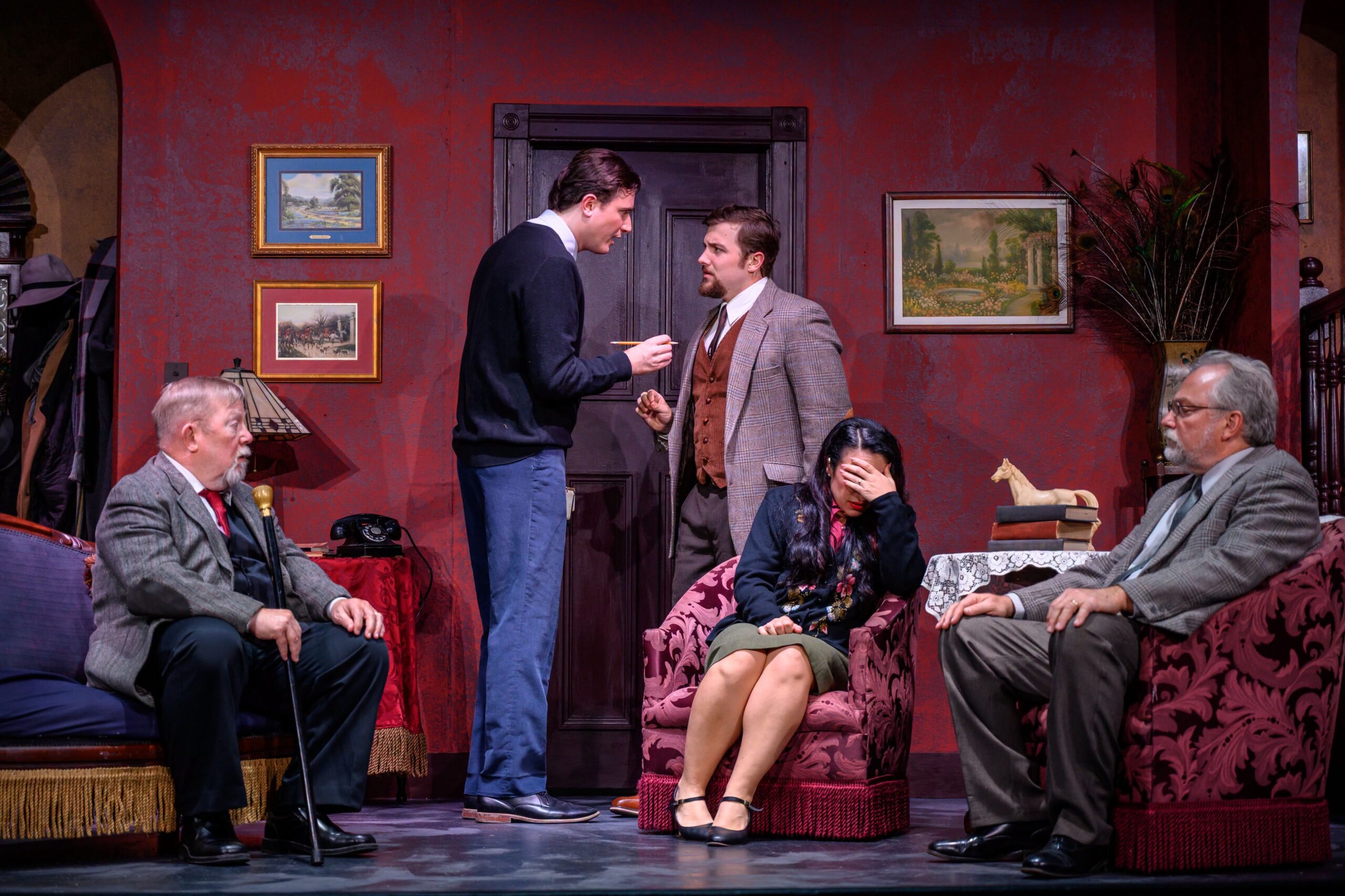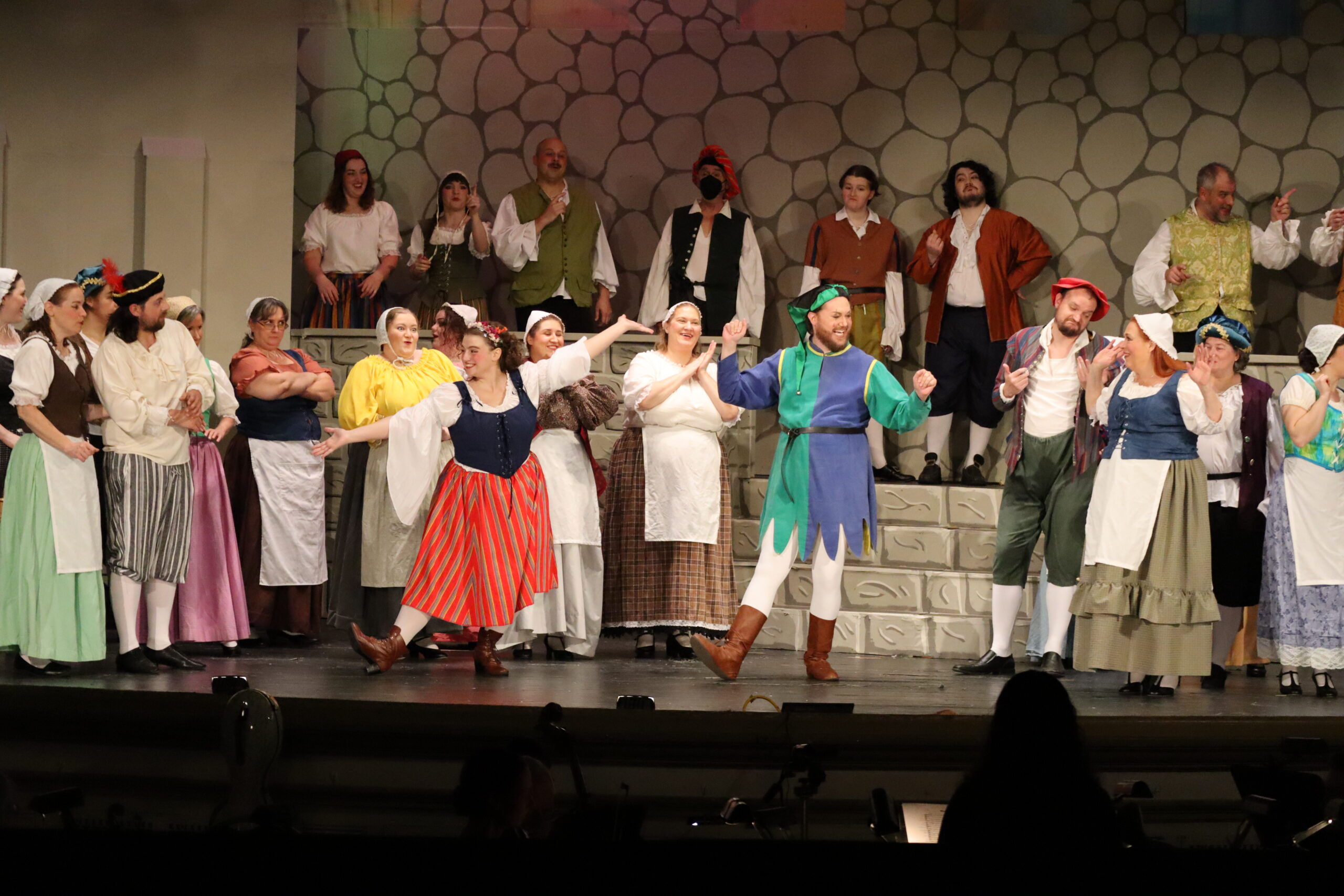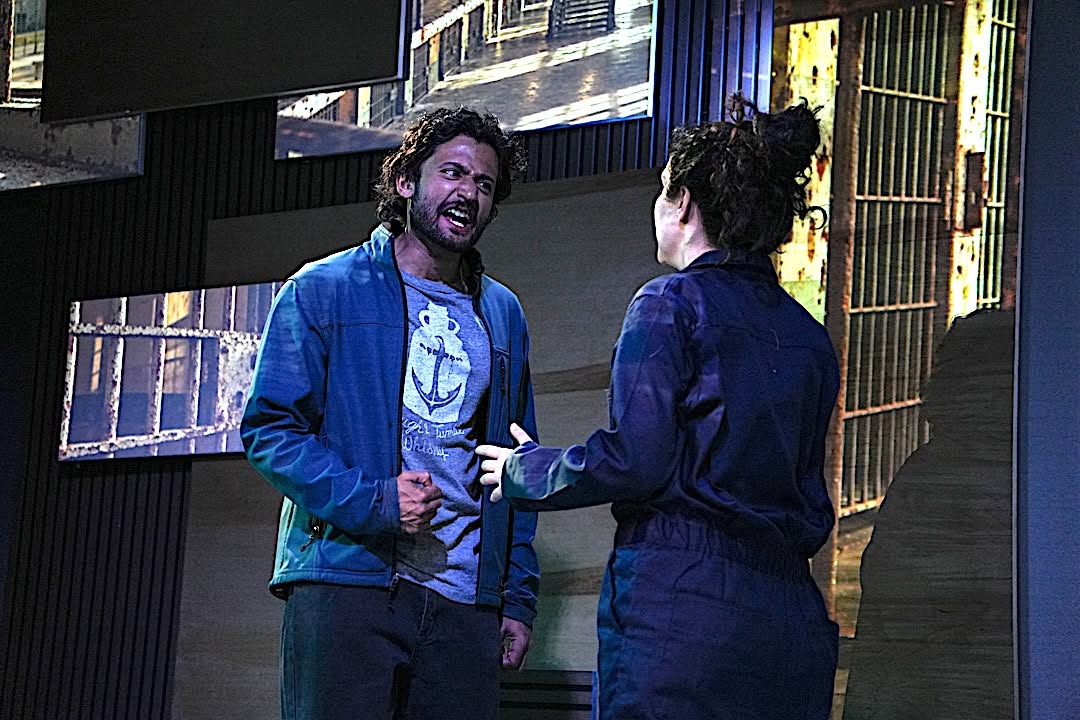
Children of the Corn – a review of “Shucked!”

By Michael Buzzelli

Two Storytellers (Maya Lagerstam and Joe Moeller) introduce us to the slightly bizarre citizens of Cobb County in the musical fable, “Shucked.”

Cobb County is a strange little place where the farmers worship the Lord Almighty and corn (they also love a good pun… and a bad one), but rarely leave the city limits.

Right before the silver queen, Maizy (Danielle Wade) walks down the aisle to marry her beau, Beau (Nick Bailey), a problem crops up, a literal and figurative crop problem. The blight on the corn crop leads Maizy (Danielle Wade) to seek answers out of town.

Maizy wanders down to Tampa, Florida, where she meets a city-slicker named Gordy (Quinn VanAntwerp), a con man podiatrist. Maizy mistakes his sign, Corn Doctor (calloused skin on a foot), for a corn doctor (the yellow grain known as Maize).

When Gordy sees Maizy’s bracelet, made from a local Cobb County mineral, the corn doctor develops a get-rich-quick scheme to pose as a corn doctor (the other kind). Maizy mistakes his con man charm for affection and kisses him.

When Gordy comes back to Cobb County with Maizy, a love triangle forms between Gordy, Maizy, and Beau. When Maizy’s cousin, Lulu (Miki Abraham), kisses Gordy, the triangle becomes a love rectangle, possibly even a dodecahedron.

Shenanigans ensue.

A photo from the national tour of “Shucked.”

Bailey is a vocal powerhouse. He belts out some beloved ballads, delivering searing lyrics in  “Somebody Will” and “OK” with a gut punch to his heart.

Abraham crushes it as a fiery and spirited Lulu, especially in her solo number, “Independently Owned.” Abraham’s comic timing is also flawless. She gets the best, bawdiest lines.

Wade is a shining star here. Her blond hair, naivete, and incredible singing voice are reminiscent of a young Dolly Parton.

Lagerstam and Moeller deliver some dumb lines with such honesty and heart that it’s easy to forgive them their pun-laden trespasses.

Mike Nappi’s Peanut is a delight. He plays the fool, but not like Shakespearean fools, wherein he says the wisest of bon mots, including, “Politicians are like diapers. They should be changed frequently. For the same reason.”

Sarah O’Gleby’s choreography is spectacular. The ensemble dances over chairs, tables, and wooden beams. The whole cast hand jives with ears of corn in a riff that would make the troupe from “Stomp!” proud. The dancing is joyous!

The playwright, Robert Horn, sacrifices the emotional heart of the story for the jokes (good jokes, bad jokes, one-liners, puns, and groaners get equal attention). The keyword of his book is “corny.”  There are some clever lines, but don’t look for sophisticated humor. Tuesday’s opening night audience was howling at the Hee-Haw humor of the show. Some lines will stay with you long after the show is over. Case in point, “Remember grandpa’s final words, ‘You boys still holding that ladder?'”

The songs by Brandy Clark and Shane McAnally capture the emotional moments when Maizy, Beau, Lulu, and even Gordy pour out their souls. The music and the dancing are the main reasons to see this gloriously performed show.

If you’re looking for mindless fun, put your brain on pause, sit down, and enjoy “Shucked!”

-MB

“Shucked!” runs until April 19 at the Benedum Center, Seventh & Penn Avenue, Pittsburgh, PA 15222. For more information, click here.
Falling Head Over Heels for Head Over Heels

Reviewed by Dr. Tiffany Knight Raymond, PhD, and Theron Raymond (seventh grade)

Head Over Heels is the finale in Pitt’s transformations-themed 2025-26 theatre season. Consciously or not, this season’s theme and rainbowed logo carry political valence.

This 2015 musical is, aptly enough, comprised of strange bedfellows. It combines Sir Philip Sidney’s 1580 work, Arcadia, with the 1980’s smash hit oeuvre of The Go-Go’s.

While separated by four hundred years, both Sidney and The Go-Go’s endure as trailblazers, making this multi-century-spanning pairing complementary rather than clashing. I still remember reading Sidney as an undergraduate English major in Brit lit I and being impressed with how contemporary this Shakespearean contemporary was. Sidney’s 1580 Arcadia was genre-bending. It was both prose and poem, and it’s considered the precursor to what we take for granted as the novel. In fact, Sidney invented the name Pamela in Arcadia. Author Samuel Richardson subsequently chose this name for his 1740 work, Pamela, which is considered the first modern novel.

As for The Go-Go’s, they burst from L.A.’s 1970’s punk scene and emerged as the first all-female band to write their own songs and play their own instruments. They skyrocketed to fame with hits like “We Got the Beat.” Their agency over their careers as women was gender-bending.

With Head Over Heels, director Kelly Trumbull consciously pulls Sidney and The Go-Go’s into the 21st century while paying homage to a past that pre-dates them both by a millennium. The plot is Oedipal in the sense that it centers around the attempt to evade a prophecy – or rather, four prophecies.

The opening song is “We Got the Beat,” which establishes an ensemble energy that choreographer Dr. Amanda Olmstead expertly guides and never diminishes. Gianni Downs’ set design is elegantly modern and symmetrical. It towers upward, and steps sweep up the opposing sides that are connected by a bridge. In the opening number, the in-sync ensemble fills the stage while Queen Gynecia (Ellie Tongel) and King Basilius (John Papadimitriou) participate from above. They look down on their subjects, reinforcing hierarchy and societal norms. The bridge is narrow while the stage is wide, visually reminding us there is only so much room at the top.

The cast. Photo Credit: Ceili Schiller

King Basilius’s confidence that he can beat the prophecies is an eyeroll-worthy textbook stereotype of royal male hubris that John Papadimitriou brings to life without making the king a caricature. Papadimitriou ventures with his manservant, Dametus (Ben Stolarz), to consult with the Oracle. The visit is sparked by the receipt of a message delivered by a serpent. Props manager, Bridgette Dona, and her team of artisans construct a snake puppet that’s worthy of a Lunar New Year parade with multiple people personing the serpent’s movement. A scrolled message drops from the serpent’s unfurling red tongue. The message is a harbinger that the kingdom’s “beat” is under threat.

Ava Kobulnicky effortlessly commands as the oracle, Pythio. When the king inquires about the oracle’s gender, Kobulnicky assertively snaps back with “How is gender germane to this discussion?” Costume designer KJ Gilmer establishes Pythio’s dominance with costumes that wow. Pythio evolves from luminescent serpent to an owl-inspired assemblage to a glimmering Emerald City-appropriate ophidian mosaic with statement sleeves that mirror the hooding of a cobra. Kobulnicky brings them to life with an indomitable, unrushed stage presence.

Like all prophecies, Pythio’s are vague but are interpreted negatively, inspiring a frenzied panic. While the king chooses not to share the specifics, he immediately shuttles his family from the city of Arcadia into the woods. The woods often symbolize freedom from regular constraints, and this musical takes that to an extreme, making the king’s attempt to escape the prophecies the very thing that allows them to flourish.

The play also opens with the king’s attempt to marry off his eldest daughter, Princess Pamela (Olivia Tran-Speros). Tran-Speros exudes a withering disdain as she scans season five of suitors, dismissing them with the flick of a royal wrist and pronouncing, “suitors do not suit and now must go.” The attempts to dodge the prophecy allow each character’s evolution without feeling forced, and Pamela’s one-dimensional spoiled princess of renowned beauty proves to be deeper.

If one sister is the beauty, the laws of siblings say the other must be plain, and such is the case with the younger sister, Philoclea (Holly Egbert). She is in love with the shepherd, Musidorus (Seamus McGroary), whom the king deems beneath her station and therefore an unsuitable suitor. After he’s denied, McGroary memorably belts out “Mad About You” with his sheep as backup dancers, affirming his resolve to pursue his love. He takes on a disguise to follow the royal family into the woods. This disguise becomes a lynchpin in the unfolding of the prophecies, and the dropping of literal and metaphorical disguises becomes a key theme of the play.

Head Over Heels ends not as a rainbowed logo, but a queer-inclusive affirmation of human storytelling. What we like to think of as modern is in fact ancient. Humans of all genders have been finding and exploring ways to love each other across time and space, and this story celebrates love in all its forms. We are as modern as we are in the past and future, and there’s comfort and solidarity in that continuity. Or, to summarize Sidney (via The Go-Go’s), “Beautiful is all I see when I look at me.”

-TKR, Ph.D. & TR

The University of Pittsburgh’s production of Head Over Heels runs through April 19, 2026, on the Pitt campus at the Charity Randall Theatre, 4301 Forbes Avenue, Pittsburgh, PA 15213. Purchase tickets online here.

Hour House—A Review of American History in 60

By Joseph Szalinski

History is written by the winners, whereas the losers write theatre criticism. At least in my case. And what better medium to teach people about history than theatre? Get lost, Ken Burns. To help get into the patriotic spirit for the U S of A’s 250th birthday, Community Theatre Players want you to catch their production of American History in 60, directed by Mace Porac, now running at Community Presbyterian Church of Ben Avon in Ben Avon, PA.

Written by playwright Jeremy Desmon, American History in 60 attempts to chronicle the story of the United States within an hour. Give or take. Who knows for sure? Time isn’t real. Farmers made it up to sell almanacs or something. I didn’t pay attention in school. Anyway. This show has the unfortunate distinction of being an American History play that’s produced in the shadow of Hamilton. Trading songs for sketches, American History in 60 seconds covers a lot of similar territory, which is the focus of most of its runtime. However, scenes that deviate from that formula really stand out, most notably: the opener about Christopher Columbus, the first Thanksgiving, the Louisiana Purchase, the beginnings of the Civil War framed as couples counseling, and a game show about the Great Depression/Dust Bowl. The ending is a bit rushed, which I guess is the point, but we’re not here to discuss the script. Just the production. Which is thankfully a frantic delight, courtesy of the cast and crew.

The cast.


True to the medium, this show would be nothing without its cast, who perform at breakneck speed to cram in the mountains of history it covers. Everyone is responsible for numerous roles, which they navigate with ease. Samantha Carpin, Tim Davis, Jenny Louise Deigan, Todd, Ellen Kalik, Shiloh Massey, Kate Miller, Mace Porac, Jenn Rian, and Jennifer Welch all work well together in their various iterations, as well as having plenty of opportunity to stand out amongst the goofiness—a gut-busting cluster of talent.

Technical elements heighten the onstage action. Lighting and sound are handled expertly by Jeff Cieslak and Patrick Trimble. Kate Miller, a member of the cast, handles the props that elevate hilarity. Director Mace Porac and Mary Witul’s handiwork in set construction helps flesh out the world, with the latter in charge of the program featuring Amy Sikora Baschnagel’s awesome poster design.

Community Presbyterian Church of Ben Avon is a relatively unassuming venue. Between its atypical façade and the quaint auditorium, one wouldn’t think that entire theatrical seasons are hosted in the hallowed space. However, after catching a few productions, it’s easy to recognize why audiences and creatives keep coming back. Whether it’s generous refreshments or the stellar people inside, it’s incredibly welcoming.

Community Theatre Players is a group of thespians committed to entertaining their audiences. Between the energy they bring to their productions and the shows they choose, they are certainly a memorable outfit amongst the dozens of other community theatre practitioners in the Greater Pittsburgh Area.

-JS

American History in 60 continues its run on.April 17th and 18th at Community Presbyterian Church of Ben Avon in Ben Avon, PA.

I Want My Baby Back Baby Back Baby Back Ribs—A Review of Agamemnon

By Joseph Szalinski

Diets have been all the rage throughout history. Germany had a Diet of Worms, Gandhi ate nothing, and lions in Rome ate Christians. Greece has been a hotbed of health fads, serving as one of the progenitors of the “Mediterranean Diet,” but before they touted the benefits of fish and fruit, they enjoyed the “Aegean Diet,” children’s pot pie. It’s because of this feast of champions, and maybe some additional sacrifice, that they can emerge victoriously in the Trojan War, which is discussed in Steel City Shakespeare Center’s production of Agamemnon, directed by Alexandra Hellinger and Lauren Scheller-Wolf, now running at West View Hubworks in West View, PA.

The first part of the Oresteia Trilogy by Aeschylus (the Daddy of Sadness)—Aggro Pokemon. No. Itchy Nimrod. No. Achey Samsung. No. Agamemnon. Yes—Agamemnon is a story about the titular king’s homecoming after a decade of fighting. While he’s anticipating a warm welcome, his wife Clytemnestra, of all people, is plotting his murder so she can get with her lover, Aegisthus. If the king gets a side piece, why shouldn’t she? Her new boo has a bone or two to pick with ol’ Aggy, which results in history’s most awful bath time. Taft’s got nothin’ on him!

Promotional poster.

The amazing actors are the backbone of this production, with most doing double duty in their roles, playing a major character and a member of the chorus. Bob Colbert is tremendous as everyone’s favorite Grecian knife block, Agamemnon. His booming voice and physicality make him seem larger than life. Sarah Elizabeth captivated as the conniving Clytemnestra, complemented by the vengeful Aegisthus, played expertly by Álvaro Muñoz. Colleen Nammond’s tremendous turn as Cassandra is foretold the moment she takes the stage. Trevor Buda has his eyes on the prize as the Watchman as well as the Chorus Leader, while Felicia Perez proclaims her prowess as the Herald. Anna Bopp, Soren Mills, and Joseph Vasquez round out the cast as impassioned players in the chorus.

Technical elements are sparse. Nearly nonexistent. Lighting is left to the ceiling bulbs. Sound is dictated by the venue’s acoustics. The handful of props and costumes merely decorate the world brought to life by the cast’s efforts. Intimate and raw, this 90-minute theatrical experience demonstrates the power of live performance.

Steel City Shakespeare Center is a terrific company that has been putting on stellar shows for several years. This is but the first production in an exciting season, and every play of theirs further proves that they are a staple of the scene. From age-old classics to more contemporary titles, SCSC has created quite a legacy for itself, inspiring and helping future generations of thespians hone their talent.

West View Hubworks is a neat performance space. Although a bit different from a typical theatre, it can still host feats of imagination and triumphs of art. Part of a larger organization that does so much to foster a better world, West View is lucky to be the home to a place where all kinds of folks can be dazzled by the talent and tenacity of people who love what they do.

-JS

Agamemnon continues its run April 17th-April 19th at West View Hubworks in West View, PA.

An Evening with two unique characters played by two XXtraordinary Actors – Review of “Breadcrumbs”

by Claire DeMarco

Alida (Virginia Wall Gruenert) talks to herself as she meanders around the stage, intent on picking up Post-it notes scattered on the floor.  She reads them, then speaks the word on each note.  Sometimes she furiously writes a new word and just as rapidly crumbles it and tosses it aside. Each word doesn’t connect with the others, but to Alida, they are remnants of a world she is slowly losing, yet trying fervently to hold on to.

Alida is in the early stages of dementia.  She is a writer and is attempting to complete what will probably be her last work.  She is naturally reclusive, not outgoing or social.

She is evaluated for dementia by Beth (Erika Cuenca), who works at a clinic.  Beth is Alida’s opposite – she’s social, vibrant, youthful, but also has her own baggage.  Both women’s problems stem from their respective pasts.

Alida lives alone and likes it, insisting she doesn’t need anyone.  She also indicates that she writes for herself, not for others.  Her life is and always has been structured.

On the other hand, Beth doesn’t like to be alone and seems to need someone at all times, especially a man.  Her life is fluid, with frequent changes (in both jobs and personal relationships).

When Beth quits her job at the clinic, she approaches Alida, proposing to help her finish her book.  And so begins a questionable union of two unique women.

At times, the women can maintain a semblance of normalcy, but as Alida’s mental acuity diminishes, Beth’s frustration rises.

Dementia affects many individuals and is devastating.  Although this is a serious play, it is not without its humorous moments.

Virginia Wall Gruenert and Erika Cuenca in “Breadcrumbs.” Photo Credit: Heather Mull Photography,

Gruenert is superb as the flawed Alida.  Her facial expressions whether it be anger, confusion, frustration or at times, a bit of happiness are excellent.  Physically she doesn’t move much on stage, walking slowly with a gait suggestive of an older woman mentally slipping away.

Cuenca shines as the young woman whose life is definitely not structured and, at times, is out of control.  She is physically active on stage, in stark opposition to Gruenert.  Her enchantment with helping Alida finish her book is evident.  Cuenca transitions easily from her usually upbeat, high-energy personality to a more subdued one when she faces intermittent confrontation with Alida.

Note: Both Gruenert and Cuenca have worked together many times, and their rapport and onstage interaction are exciting to watch. A dynamic duo excellently directed by Ingrid Sonnichsen.

The set is simple with a desk and two chairs.  It is the backdrop that provides an emblematic symbol of Alida’s decline.  Several rows of airy, see-through.  Material resembling leafless tree stumps provides a backdrop that Alida often meanders through, symbolizing her declining mental health. Tree leaves are scattered on the stage.

This production is a farewell from Virginia “Ginny” Wall Gruenert.  Many theater productions were produced by off the Wall at Carnegie Stage.  “Breadcrumbs” is a personal thank you from Ginny to all those patrons who have supported her over the years.  Now residing in Iceland, she is planning new adventures there.

-CED

“Breadcrumbs” is a production by Wall Stageworks dba off the Wall & Viva Holding, Iceland. Performances run from April 10th to April 18th at Carnegie Theater, 25 W Main Street, Carnegie, PA. For more information, click here.


Thornton gets Wilder – a review of “Our Town”

By Michael Buzzelli

The Stage Manager (Cecilia Staggers) welcomes us to the burgeoning burg of Grover’s Corners at the turn of the century in Thornton Wilder’s “Our Town.”

The omniscient and omnipresent Stage Manager acts as the god (small g) of Grover’s Corners, citing facts and statistics, and even gathering local experts, Professor Willard (Nathan LeSane, III) and Editor Webb (Gabriel Hammesfahr), to pinch-hit with historical and anthropological data.

The aforementioned Stage Manager introduces us to two local families, the Webb family and the Gibbs family.

Mrs. Gibbs (Emilee Edick) is having trouble with her son, George (Rayhan Khimji), who has been playing baseball and ignoring his chores. George also has a crush on the neighbor girl, Emily Webb (Emma Delaware).

Even though “Our Town” follows many of its citizens, George and Emily’s romance is the centrifugal force around which the play rotates. The audience is invited to their most significant interactions, including their hesitant courtship, first date, and wedding day.

On the wedding day, Mrs. Gibbs is reluctant to let George go. She’s afraid he won’t be able to get on without his mother at his side. Later that same morning, Mr. Webb has an excruciatingly awkward chat with George.

Things move along happily for George and Emily, but “Our Town” has three distinct acts:

      • Daily Life
      • Love & Marriage
      • Death & Eternity

Suffice to say, life has a bad habit of ending.

The townspeople gather for a wedding. Photo Credit: Kgtunney Photography
George Gibbs (Rayhan Khimji) gets ready to walk down the aisle. Photo Credit: Kgtunney Photography
Mrs. Gibbs (Emilee Edick) and Ms. Webb (Ocean Chang) reveal secrets while shelling peas. Photo Credit: Kgtunney Photography

The cast is enormous, but there is no weak link. Each player seems to have an integral part to play in the small-town life of Grover’s Corners.

Because Director Ricardo Vila-Roger lets the actors lean into the humor, he lets Thornton get wilder.

Staggers (no stranger to Pittsburgh stages) is, much like her character, a force of nature. She is a warm, inviting host, filled with the gravitas of the role. She also manages to deliver humor with a wry smile or a subtle gesture.

Khimji is a breakout here. He is charismatic and charming in every scene, playing a younger George very differently from the older George (even though the age is only a few years apart). Young George is earnest and innocent. Older George stands up for his convictions and is passionate about his interests, especially his betrothed.

Delaware’s Emily also grows up between acts one and two, but learns the most during act three (even though the play is nearly a century old, there will be no spoilers here). Delaware has to hold Act Three together nearly by herself, but she does it with aplomb.

Hammesfahr figuratively and literally, leans in hard. The actor matches the kinetic and comedic spirit of a young David Hyde-Pierce. He is magnetic to watch. Each line is delivered with his own remarkable style.

Edick’s Mrs. Gibbs is a sympathetic character. She and Chang have a heartfelt scene together, shelling invisible peas. It’s superb acting from both actors.

Other standouts include – but are not limited to –  Ocean Chang’s Mrs. Webb, Devin Claudio’s Howie Newsome, Kennedy Hawthorne’s Rebecca (“I love money) GIbbs, LeSane’s bespectacled Professor Williard, and Allie Wahl’s Mrs. “I love a wedding” Soames.

Damian Dominguez’s costumes are Abner Doubleday meets Edwardian elegance. Stiff collars and long dresses, perfect for the era.

There isn’t much to the set until a third-act reveal, which is a stunning work by Scenic Designer Johnmichael Bohach.

When the play starts, it’s dawn in Grover’s Corners, and Lighting Designer Piper Steffek brilliantly illustrates that morning light.

One note of improvement: Actors need to get a little better with their space work, the placing and replacing of imaginary objects. An actor sets down an imaginary cup of coffee on a table, and then glides his hand right through the space where the cup was last placed. If it were a real mug of coffee, it would have splattered all over the floor.

This is not your father’s “Our Town.” It bursts with energy. Because it’s so alive with humor, the third act’s impact is devastating. If you’ve seen “Our Town” and didn’t like it, now is the time to give it another try. And if you love the show, you must go!

-MB

“Our Town” runs through April 12 at the Highmark Theatre, inside the Pittsburgh Playhouse, 350 Forbes Avenue, Pittsburgh, PA 15222. For tickets or more information, click here

The Face of Change – a review of “Paradox of Education.”

By Michael Buzzelli

“Not everything that is faced can be changed, but nothing can be changed until it is faced.”

-James A. Baldwin

Madison & Taylor College President Woods (Stacey Rosleck via video) welcomes incoming freshmen, Makeda (Marissa Lily) and Xavier (Manny Waker), to the Black Excellence Scholarship program, wherein the two meet the remaining members of the program in a room at the student union in Ty Greenwood’s “Paradox of Education.”

Madison & Taylor College is a thinly veiled reference to Greenwood’s alma mater, Washington & Jefferson College (think: “If Beau Street Could Talk”).

Ebony (Krystal Waller), president of the student group, wants her other members, Miles (Amon Jamaal), Zara (Tajinna Clinton), and Emmerson (Brenden Peifer), to be on their best behavior when meeting the new kids. Miles and Zara want to warn the incoming frosh that the college made a lot of false promises, such as the benefits and amount of the scholarship, the school’s rampant racism, and the racism in the surrounding community. Most of the promises came from a campus Administrator (Melissa Edmond), who is the queen of microaggression. She says a few things out loud that would make your average Karen cringe, including “Have you ever read a philosophy book?”

Emmerson struggles with his status as a mixed-race kid, while Zara, Miles, and Ebony dismiss his problems because he’s light-skinned (Colorism). Meanwhile, Emmerson confesses to the Administrator that he doesn’t feel wholly comfortable in Black or white spaces.

When a tragedy happens on campus, the students have to grapple with their feelings over the inherent racism and their own prejudices.

Ebony (Krystal Waller), Emmerson (Brenden Peifer), Makeda (Marissa Lily), Xavier (Manny Walker), Miles (Amon Jamaal), and Zara (Tajionna Clinton) discuss campus issues in “Paradox of Education.”

The play is superbly and authentically acted. At times, the dialogue feels real, as if each actor is having the thought out loud for the first time.

Waller’s Ebony leads this small army of freedom fighters.  Waller manages to find the wisdom and grace in her character. She commands herself like the leader Ebony is meant to be.

Peifer always enchants. He is likable and charming even when his character is saying the wrong thing. His charm makes the event that leads to the second act (no spoilers) even more tragic.

Walker is restrained here. His Xavier has an arc. He goes from timid newcomer to strident supporter of causes.

Carter’s Zara is the most difficult character to like. She is played with an almost sociopathic lack of empathy, but when Carter nails a monologue about death, you can see that her character’s emotional distance is a protective device. The actor finds beauty in the cracks.

Lily’s Makeda has an epic Slam Poetry moment about her hair. She is also the emotional heart of the story, leading with compassion.

Jamaal plays Miles as an affable student. His best scene is in his reactions to Edmond’s Administrator as she continues to subtly and not-so-subtly put him in a narrow, Black box.

The cast is completed by Rosleck, Charles Timbers, Jr., and Richard McBride, appearing in recorded voices and video, but not on the actual stage.

Producing Artistic Director Mark Clayton Southers also designed the set, which looks as if it were plucked from an august university and dropped into the Madison Arts Center.

Director Maurice Redwood is an impressive leader. He gets convincing performances from each actor. The play is infused with youthful vitality.  Redwood also shot and directed the video transitions, intermingling shots of the real, predominantly white institutions (PWIs) and their mostly white students.

Greenwood’s play wrestles with serious issues, a tragic turn, and some divisive opinions. While the play could use a little more dramaturgy and editing, the subject matter is more relevant than ever. Greenwood’s play may be preaching to the choir, but the message is still important. “Paradox of Education” is thought-provoking and emotional.

To quote Redwood, “This powerful, thought-provoking production follows six Black students navigating life at a predominantly white institution, confronting the realities of race, identity, and belonging. It’s raw. It’s honest. It’s necessary.”

-MB

“Paradox of Education” runs until April 20 in the Carter Redwood Theater, inside the Madison Arts Center, 3401 Milwaukee Street, Pittsburgh, PA 15219. For tickets and additional information, click here.


Schoolhouse of Cards: A Review of Ridiculous

By Timothy Ruppert

“It’s the Cultural Trust,” magician David Williamson reminded the audience on the opening night of his delightfully ebullient show, Ridiculous. “It’s supposed to be art!” His legerdemain satisfies that qualification from the very first trick, proving card after card that Williamson is a Dalí of light-speed sleight-of-hand. Yet his act has great dimensionality beyond clocking decks and tracking shuffles. As a humorist, Williamson puts one in mind of Phil Silvers, with a faux exasperation that never quite conceals the very real heart behind every gag. Williamson’s flawless intermingling of illusion and levity renders this show terrifically impressive, a joyful mélange of distractions.

Williamson himself possesses a likeably avuncular air equally suited to brash mischief or quiet wisdom. Blue-suited and yellow-vested, Williamson has the look of the great Ian Richardson as he appeared in the 1990s British series House of Cards—Francis Urquhart with a benevolent soul and several wicked packs of cards. All the evening’s tricks are performed with help from audience volunteers, older and younger people alike, contributing to a show designed like a Fibonacci sequence, progressing in scope and complexity without ever losing the semblance of natural, logical progression. Taken together, these qualities of Ridiculous and its star make the show ideal for families and fellow travelers, especially those who appreciate the mirth and adventure afforded by Williamson’s interactive wizardry.

Magician David Williamson

While Ridiculous offers numerous tricks that evolve in complexity and intensity over the course of the evening, ranging from sealed envelopes to a magic paper shredder to citrus fruits, the show frames its wonders decisively within an intellectual context. Williamson cites the importance of “793.8,” the Dewey Decimal designation for books, such as S. W. Erdnase’s 1902 The Expert at the Card Table, on performing magic. At another point, he quotes speculative-fiction writer Arthur C. Clarke’s remark that “any sufficiently advanced technology is indistinguishable from magic”—a maxim that places the enigmatic within orbit of science and art. Williamson rarely misses a chance to philosophize about his craft, encouraging us to consider the liminal spaces between mirage and reality without diminishing the mystique of his act. And so, when he urges one young assistant from the audience to “treat this as a think piece,” Williamson strives after far more than comedic effect. For all its heart-lifting entertainment, Ridiculous serves too as an open course in the psychology of theatricality, a thoughtfully structured and lovingly presented seminar in spectacle that reflects Williamson’s many years as an inestimable performer and indefatigable advocate for the creative spirit.

And there one finds the true magic in Ridiculous. Williamson’s love for his art and for those who share in its expression carries the freight of a lifetime devoted to both the theory and the practice of amazement. Like any memorable piece of theatre, Ridiculous has a past, a present, and a future, reflecting years of training and research manifest in the here and now to inspire a new generation to seek out astonishment. For an evening of incredible magic rendered with talent, thought, and heart, make sure not to miss David Williamson and this hilarious and edifying schoolhouse of cards.

-TR

Ridiculous” plays through Sunday, May 3, at Liberty Magic, 811 Liberty Avenue, Pittsburgh, PA 15222. Visit here or contact the Liberty Magic box office at 412-456-6666.   


Backstage Pass – a review of “10 Out of 12”

By Michael Buzzelli

When you’re in a show, all through rehearsals, Tech Week hovers out there like a magical holy grail. In reality, Tech Week is always a train wreck of missed cues, forgotten lines, malfunctioning set pieces, and short tempers.”
 – S.M. Stevens

For actors, Tech Week has always been the moment magic and mayhem collide. It’s never been better represented than in Anne Washburn’s hilarious and immersive play, “10 Out of 12.”

When you enter the Mellon Institute Library on the University of Pittsburgh campus, you are given a headset. Real Life Associate Producer and Patron Relations Manager Hazy J will show you how to wear and operate the headset. They will be one of the few real-life crew members you will meet.

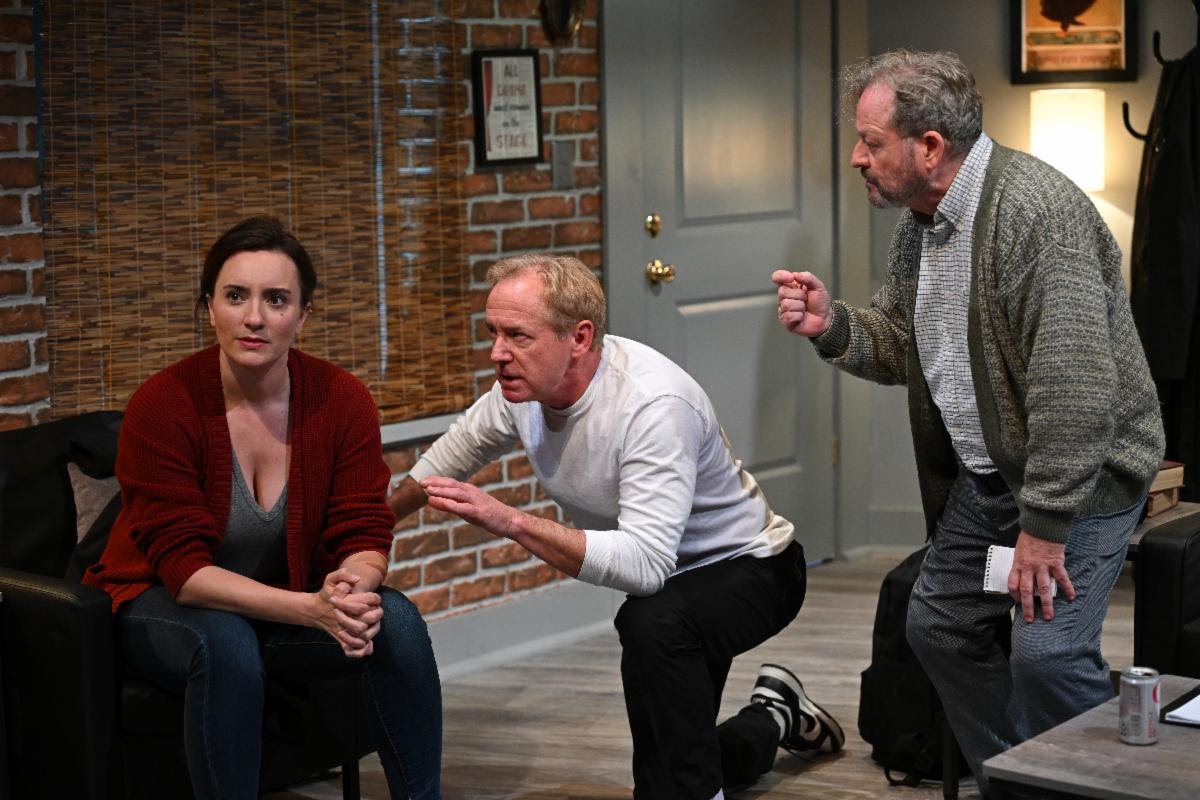
In this show, the actors play stage crew, the director, and even, oddly enough, actors.

Elliot (Tim McGeever) is directing a troubled production of an untitled play. While Molly (Jamie Agnello), the stage manager, and crew members, Eric (Conor McCanlus), Jamie (Olivia Ruhnke), and the assistant director, Diego (José Pérez, IV), run around making last-minute adjustments.

Ben (Mark August) plays Charles in the show-within-the-show. His character may or may not be in love with Richard (Evan Vines), played by a TV and film actor named Jake (think Elordi, but it could easily be any Tom, Dick, or Timothée).

Jake has his eyes on the leading lady, Eva (Melessie Clark), and a showmance develops.

Waiting in the wings is Paul (Corey Rieger), who brings a boatload of added tension to the production.

Headset hilarity ensues.

Tensions rise, and the mousetrap snaps shut!

P.S. There is a reference to a mouse in the show, but mousetrap is being used in the Shakespearean context of a show-within-a-show.

Eva (Melissie Clark) and Jake (Evan Vines) take five in “10 Out of 12.” Photo Credit: Jason Cohn.

The acting is superb. Washburn’s comedy comes from a real and heartfelt place. The characters seem real, lived-in.

On every crew, there is a crew member who makes themselves so indispensable that they refuse to leave the set when injured. McCanlus milks out every bit of humor from each of his lines without being over-the-top or unreal. The performance is so genuine. The only thing missing was the cargo shorts.

McGeever’s Elliot is our tour guide into this unique world.  His frustrations are delightfully comic.

Pérez is in top form here. His character is so hopped up on Jake’s rizz that he blunders in every interaction with the movie star. It’s comic, but. Once again, coming from a grounded place.

Shammen McCune plays a variety of roles, each with an unflattering name and/or profession. She plays Old Lady, Imp, and whore. Each character is unique. Lucille, the aforementioned harlot, is so far from her normal slate of imperious and regal characters that it’s astonishing.

Rieger shines bright in “10 Out of 12.” His Paul is a temperamental genius, admired and feared by cast and “crew.” He brings a gravitas that befits the role. Rieger gets two brilliant monologues that will be oft-repeated in auditions by actors and wannabe actors far and wide.

Clark is another delight here, lighting up the stage with her mere presence. Her best scenes come in stolen moments between snafus. Her chemistry with the rest of the crew is palpable. Her interactions with McCune and August between “scenes” are filled with loving energy.

August is terrific here. His Ben is an affable actor, but his Charles gives off Matt Berry vibes (“The IT Crowd,” “What We Do In Shadows,” etc.).

Runke and Agnello’s best lines are delivered over the headsets, but they nail each one.

It won’t be long before Vines develops a fan base like his character. He is charming and charismatic on the stage.

Now onto the real behind-the-scenes crew:

It’s another fantastic set by the “retired” Tony Ferrieri. The set opens like a Mad Magazine Centerfold or a Barbie Camper, transforming from a Victorian Drawing Room to a Cartoon Jungle.

Carrie Ann Huneycutt’s costumes are perfect for the on-stage actors and crew (though I really would have put McCanlus in Cargo shorts).

The madness is deftly directed by Andrew William Smith (a longtime Quantum actor, now behind the scenes).

Warning: Actors in the audience may experience PTSD, but in the most fun way possible. Side note: In actual productions. There’s a lot more yelling.

“10 Out of 12” is part “Noises Off,” part “The Play That Goes Wrong,” but with added layers of depth. Washburn and Smith manage to work in some “Locals Only” jokes that are uniquely Pittsburgh.

“10 Out of 12” isn’t just the title. It’s the number of stars in the production’s rating.

-MB

“10 Out of 12” runs from April 3 to April 26 at the Mellon Institute, Fifth and  Bellefield (use the Bellefield entrance), Pittsburgh, PA, 15213. For tickets and additional information, click here.


Have Red Shoes, Will Travel – Review of “The Wizard of Oz”

by Claire DeMarco

Dorothy Gale (Alaina Turocy) lives with her Aunt Em (Greta Healy) and Uncle Henry (Anthony Costulas) and her beloved dog, Toto.  Dorothy is a dreamer, wishing for a more exciting life than the one she has now in Kansas.

After a kerfuffle with nasty Miss Gulch (Mairead Roddy) over Toto, Dorothy runs away from home.  Along the way she meets Professor Chester Marvel (Patrick Conner), a kind but obvious con man. With his crystal ball he just happens to have with him, he seems to know a lot about Dorothy.  Playing on Dorothy’s emotions, Marvel suggests that Aunt Em is ill and needs her back home.  And anyway, Dorothy, there’s a big storm coming!

Dorothy and Toto make it home but not in time to avoid it.

When the violent tornado strikes, Dorothy and Toto are swept up in her house and land unceremoniously in the magical kingdom of Munchkinland, killing the Wicked Witch of the East as they plummet to the ground.

Now more than ever Dorothy yearns to go back home.  The Munchkins and Glinda the Good Witch (Greta Healy) tell her she needs to get to Oz and find the Wizard of Oz.  He can help her. “Follow the Yellow Brick Road.” You can’t miss it!

Glinda gives Dorothy a pair of magical red shoes meant to protect her from the evil Wicked Witch of the West (Mairead Roddy) who’d love to have those shoes to enhance her power.

As Dorothy travels towards Oz, she meets three fascinating characters.

Scarecrow (Timothy Macuski) laments that he doesn’t have a brain.  He’s stuffed with straw.  “Woe is me,” Dorothy encourages him to come to Oz with her and see the Wizard.

The next encounter in their travels is with Tin Man (Cole Vecchio), whose many body parts have been replaced with tin due to accidental mishaps.  He is prone to rusting but becomes the third part of the traveling group. Tin Man wants a heart.

Their final traveling companion is Cowardly Lion (Cole McGlumphy) whose attempts at bravery fall short.  He is fearful and even afraid of heights.

After many trials, adventures and tribulations as they travel, the foursome finally reach Oz. They are a cohesive unit, each supporting and encouraging one another.  After much cajoling, they meet the famed Wizard of Oz (Patrick Conner).

Do the travelers find the strengths or attributes they think they lack, or do they realize they had them all along? We all know the answer, but it’s about the journey not the destination.

Travelers to Oz include The Tin Woodsman (Cole Vecchio), Dorothy Gale (Alaina Turocy), The Cowardly Lion (Cole McGlumphy), and the Scarecrow (Timothy Macuski). Photo Credit: Alexis Hawk

See this wonderful production of a classic, and you’ll find out!

Note: It was great to see so many young attendees (and hopefully future theatergoers) at the show.

Turocy’s performance grows as she transitions from a girl not satisfied with her life to a caring supporter and cheerleader to the new friends she meets on the way to Oz.  She sings a wonderful rendition of “Somewhere Over the Rainbow.”

It’s so easy to love Macuski as the gentle and kind Scarecrow.  He professes that he doesn’t have a brain, but he often comes up with clever ideas as the journey to Oz continues.

Vecchio’s Tin Man often frets that he doesn’t have a heart, but his compassion is evident as he cries at his companions’ dilemma in the poppy fields.

With a wonderfully timed comedic flair, McGlumphy shines as the cowardly lion, afraid of his own shadow.

Macuski, Vecchio, and McGlumphy entertain with renditions of the song “If I Only Had …,” inserting a brain, heart, or nerve applicable to their situation.

Roddy explodes on the stage as the “Wicked Witch of the West”.  Always calculating, cackling, and conjuring up schemes to get Dorothy, her facial features as the conniving witch are spot on.

Conner, as the smooth-talking Professor Marvel and part con man, somehow knows a lot about Dorothy. He is dramatic and strong, yet subtly shifts into a gentle, soft-spoken grandfather type as he convinces Dorothy to return home.

With a trilling, sugary sweet voice and constantly holding or waving a wand, Healy epitomizes goodness.

There are nineteen delightfully talented children in the Child Ensemble, all with wonderful singing voices and coordinated dance steps.

Applause to the Adult Ensemble whose timing, singing, and exceptional acting contribute to the success of this musical production.

Dylan Blussick does an outstanding job as costume designer, creating many clever, unique, and colorful designs.

An additional list of reasons to see this production:

    • Great work by Choreographer Caroline Connell.
    • Marvelous makeup by Makeup Artist Dylan A. Blussick.
    • Shout out to Music Director Daniel Guillaro and his accompanying musicians.
    • Excellent direction by Patrick Cannon.

“The Wizard of Oz” was written by L. Frank Baum with Music and Lyrics by Harold Arlen and E. Y. Harburg.  Background music by Herbert Stothart.

-CED

The Wizard of Oz” is a production of Little Lake Theatre Company.  Performances run from April 2 to April 19th at Little Lake Theatre, 500 Lakeside Drive, Canonsburg, PA. 15317. For more information, click here.

css.php